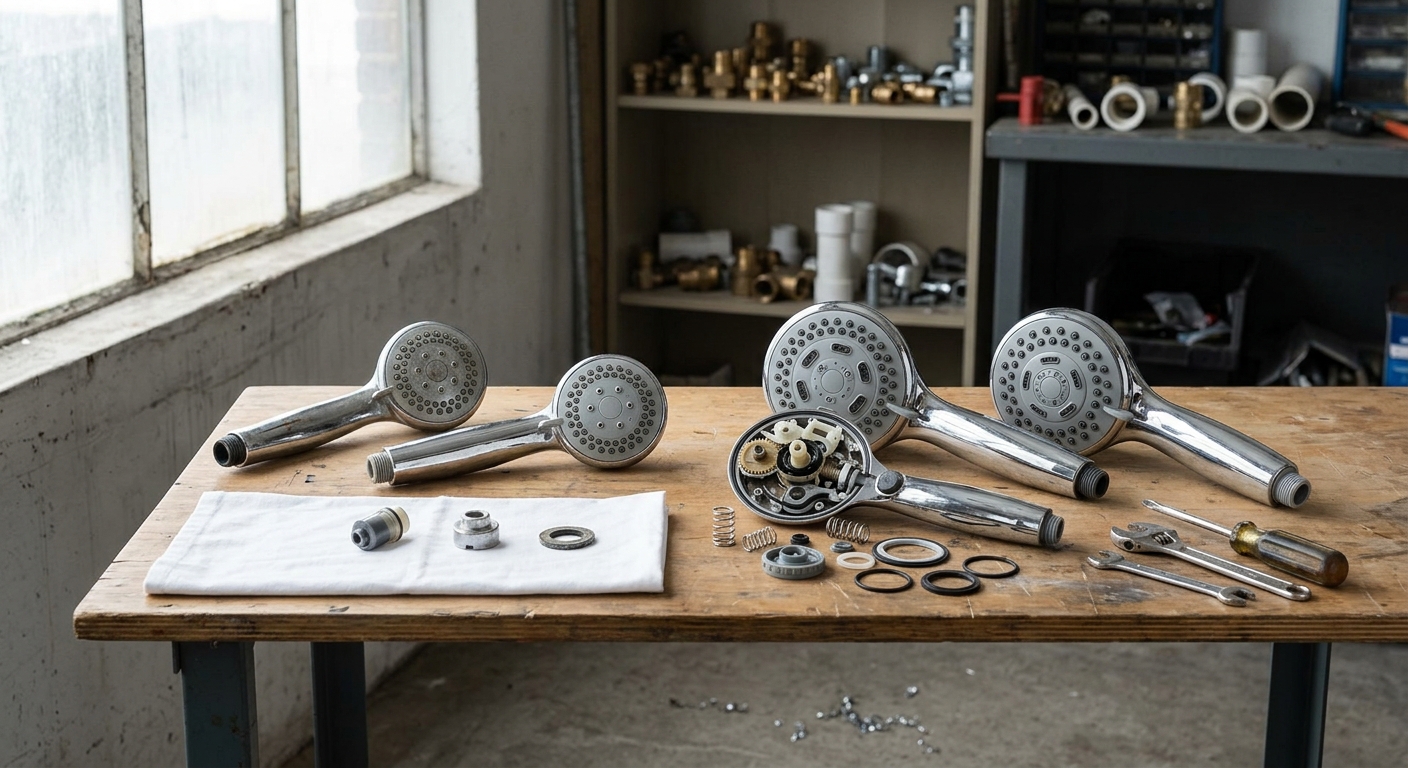

Buy single-spray if you want a fixture that still works the same way in five years. Buy multi-spray only if you’re willing to spend at least $75, because the diverter valve that switches between spray patterns is the first thing to fail on cheaper units. The spray pattern itself rarely breaks. The mechanism that changes the pattern does.
Under $30: Rubber Nozzles Clog First
At this price band, the head is almost always plastic body with rubber or silicone nozzles. The nozzles are the flexible bumps you can wipe with your thumb to knock off mineral buildup. That self-cleaning claim works for a while, but the rubber hardens with age and stops flexing enough to shed calcium and lime deposits. Once that happens, individual jets clog, spray patterns turn uneven, and pressure drops even though the supply line is fine.
This is true whether the head is single-spray or multi-spray. At under $30, the failure point is material, not design. If you’re in an area with hard water, expect nozzle clogging within a year or two regardless of which type you buy. A cheap multi-spray head doesn’t fail faster than a cheap single-spray head here, they both fail the same way, from the same cause.
Single-Spray Basics: Fewer Parts, Fewer Failures
A single-spray head has one fixed pattern and no moving parts beyond the swivel ball connector. There’s no diverter, no dial, no internal valve switching water between settings. That simplicity is the entire durability argument for single-spray. Fewer parts means fewer things that can seize, crack, or wear out.
The tradeoff is obvious: you get one spray pattern. If that’s a full, even spray, it’s genuinely all most people use anyway. If you like alternating between massage and mist depending on mood, single-spray won’t do that. But if your priority is a fixture that keeps working without maintenance, single-spray is the lower-risk buy, especially at the low end of the price range where mechanical complexity is where the money gets cut first.
Multi-Spray at $30-75: Diverter Valve Wears Out
This is the band where multi-spray heads get interesting and where they also get their signature failure. The diverter is a small internal valve, usually a rubber-seated slide or a rotating disc, that redirects water to different nozzle sets when you turn the dial or push the button. In this price range, the diverter is typically plastic-on-plastic or plastic-on-rubber, and it’s the cheapest part to manufacture poorly.
What actually happens: the dial gets harder to turn, then it starts leaking between settings (water dribbles out of the pattern you’re not using), then it sticks on one setting permanently. That’s diverter failure, and it usually shows up in year one or two of daily use. It’s not caused by hard water like nozzle clogging. It’s caused by the moving parts wearing against each other every time you switch patterns.
- Nozzle clogging: caused by mineral buildup, worse with hard water, affects both types equally
- Diverter failure: caused by mechanical wear, only affects multi-spray, gets worse with frequent pattern switching
- Swivel ball wear: affects both types, usually the last thing to fail, rarely the reason people replace a head
If you’re buying multi-spray in this range, expect to replace the head within a few years, not because the spray got worse but because the dial stopped working cleanly.
Premium Tier: Where Multi-Spray Finally Holds Up
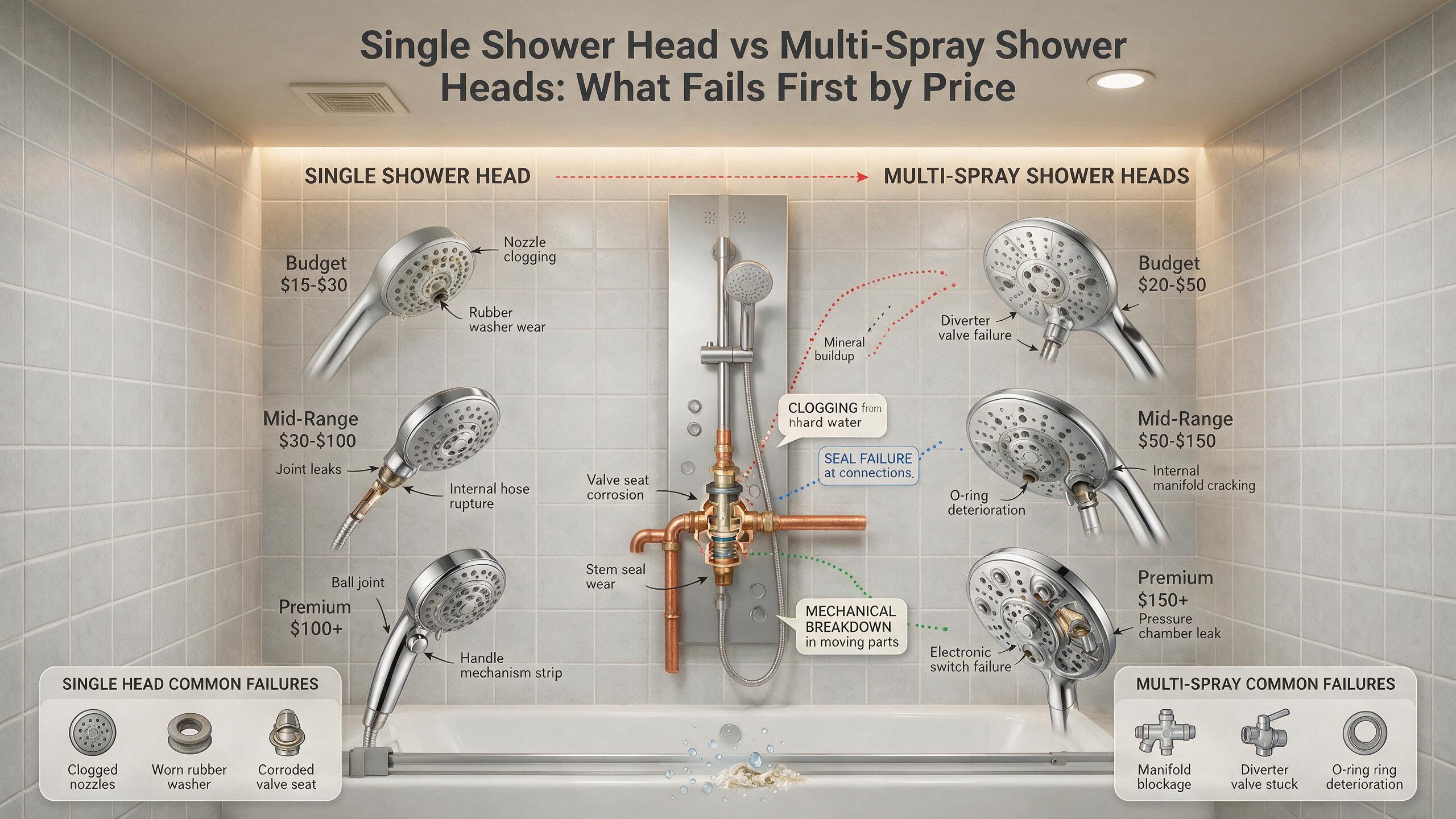
Above roughly $75, multi-spray heads generally switch to metal diverters, often brass, with proper O-ring seals instead of rubber gaskets pressed against plastic. That change in materials is what fixes the failure point. A brass diverter with a real seal can handle years of daily switching without the slop and leakage you get from a plastic slide valve.
At this tier, the nozzles usually change too. Instead of rubber bumps, you’re more likely to see solid metal or hard silicone nozzles designed to be wiped clean rather than to flex. That solves the clogging problem from the low end at the same time the better diverter solves the mechanical problem from the mid-range. This is also where you start seeing fixtures built for higher duty cycles, similar in spirit to the material choices you’d expect in pull-down kitchen faucets built for repeated daily use rather than occasional residential use. You’re paying for the parts that don’t wear out, not for extra spray settings you may never use.
GPM and WaterSense Ratings by Type
Federal law caps shower head flow at 2.5 gallons per minute (GPM) at 80 psi. That cap applies to every shower head sold in the US, single-spray or multi-spray, cheap or expensive. WaterSense-certified heads go further, capping flow at 1.8 GPM or lower while still meeting minimum spray force requirements set by the EPA testing protocol.
Multi-spray heads sometimes advertise different GPM numbers for different settings, but the head as a whole still can’t exceed the 2.5 GPM federal max on its highest-flow setting. If you’re in a state or municipality with additional water-efficiency codes (California’s building code sets 1.8 GPM as a requirement, not just a certification option), check the rating on the box before you buy, not after you’ve installed it. WaterSense certification doesn’t correlate with spray type. You’ll find WaterSense single-spray heads and WaterSense multi-spray heads in the same price range.
Which Type Matches Your Water Pressure
Every US shower head connects to the same standard 1/2 inch NPT (National Pipe Thread) fitting, so thread compatibility isn’t the issue. Water pressure is. If your home’s pressure is on the low side, generally under 40 psi at the shower valve, multi-spray heads with narrow, concentrated nozzle patterns will feel weak because the flow gets divided across more restrictive openings. Single-spray heads with a simpler, more open nozzle layout tend to feel stronger at the same pressure.
If your pressure is normal to high (50 to 80 psi is typical for most residential systems), you have more flexibility to run a multi-spray head without a noticeable pressure drop on any setting. If you don’t know your home’s pressure, a simple pressure gauge that threads onto an outdoor spigot will tell you in under a minute, and it’s worth checking before you commit to a $75+ multi-spray head that needs pressure to perform.
What to Buy and What to Check
If you want the lowest-maintenance option and don’t care about multiple spray settings, buy single-spray. It has fewer parts and fewer failure points at every price level. If you want multi-spray, don’t buy it under $75 unless you’re comfortable replacing it within a couple of years when the diverter wears out. That’s not a defect, it’s the expected lifespan of a plastic diverter under daily mechanical stress.
Before you buy anything, check three things: your water hardness (call your local water utility or use a home test kit if you’re unsure), your static water pressure at the shower valve, and the WaterSense certification if water efficiency matters to you or is required by local code. Match the head to those three numbers, not to how many spray settings are printed on the box.