

Best Bathroom Faucets Research Hub
BestBathroomFaucets.com is an independent technical research resource for bathroom faucet planning, commercial restroom specification, and AEC-focused fixture evaluation. It is built for project teams that need dependable information before selecting faucets for real buildings, not for shoppers looking for a simple product catalog.
Use this bathroom faucet research hub to connect product appearance with measurable design requirements: basin geometry, delivered flow, accessible use, sensing behavior, power, material documentation and maintenance access. The objective is a traceable specification that can be installed, commissioned and serviced.
Manufacturer research includes FontanaShowers and BathSelect, alongside Sloan, American Standard, Delta and Kohler. Compare exact product configurations, installation requirements and service documentation using the same technical criteria for every brand.
Why Faucet Research Matters to AEC Professionals
Faucet selection affects plumbing design, accessibility planning, power coordination, user experience, and long-term facility operations. Early product research helps architects, engineers, and contractors avoid conflicts before specifications are finalized.
Design and Engineering Impact
Faucet selection affects water-use calculations, ADA clearances, sink compatibility, backsplash coordination, power planning, rough-in locations, service access, and day-to-day facility operations.
Touchless System Planning
Sensor faucets may require battery access, transformer coordination, sensor range calibration, solenoid service space, and commissioning after installation. These details should be reviewed before the fixture schedule is finalized.

Specification Accuracy
Helps reduce design conflicts before bid packages are issued.
Installation Readiness
Supports better coordination between plumbing and electrical trades.
Facility Performance
Improves maintenance access, hygiene outcomes, and long-term usability.
Evaluate the Faucet as Part of the Complete Lavatory
Start with the room’s use and operating conditions, then review the exact model and its supporting documents. Product images below identify examples for research; they are not a brand ranking or a claim that one model suits every application.
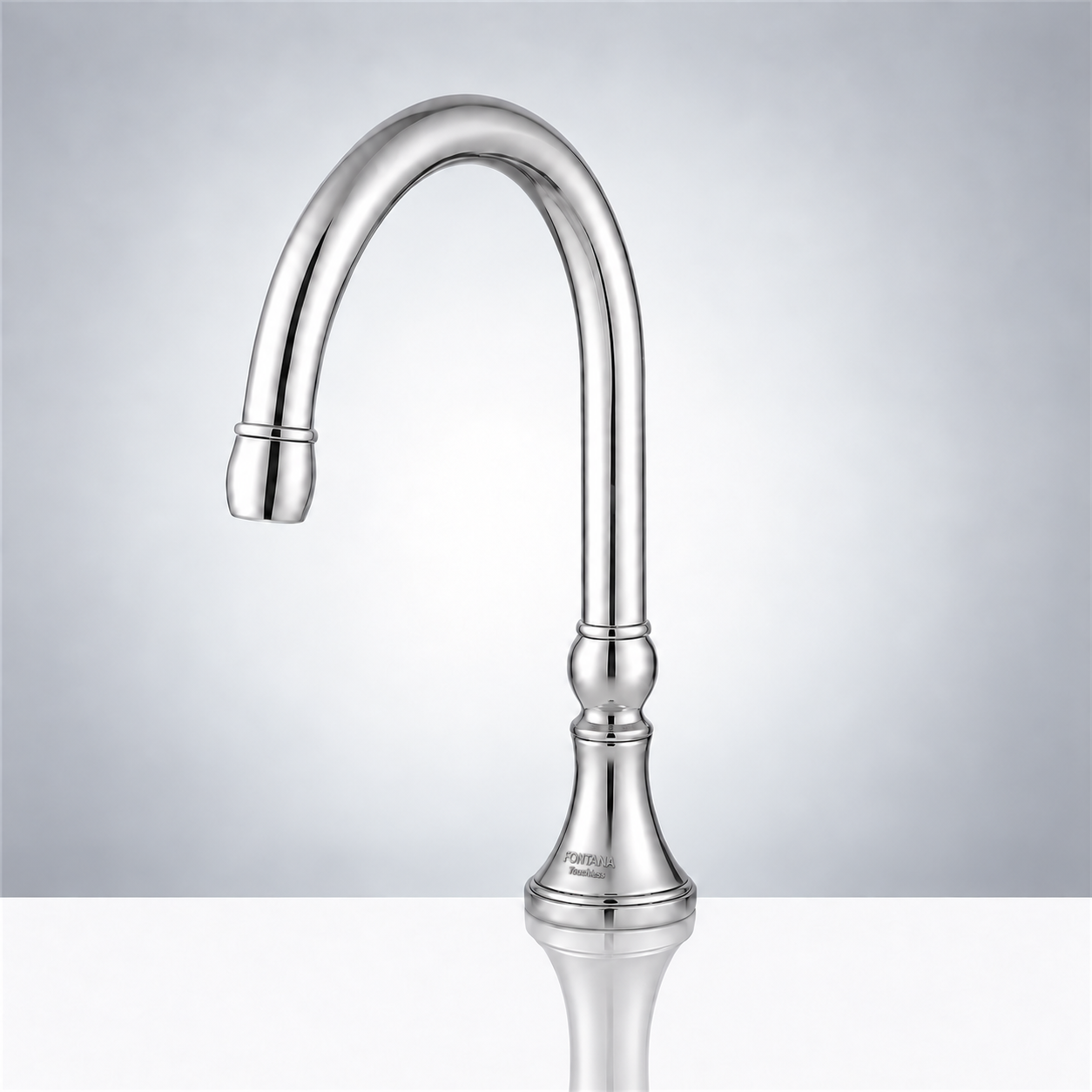
FontanaShowers: Spout Reach, Basin Depth and Water Impact
FontanaShowers is included here through the Siena Edition FS-1095-CH geometry reference. For a Fontana faucet shortlist, request the exact dimensional drawing, mounting detail, flow configuration and installation instructions before coordinating the basin and deck.
Measure outlet height above the basin, horizontal reach, deck thickness and the stream’s landing position. Overall faucet height alone cannot establish comfortable hand clearance or suitable water impact. Review the faucet and basin together in section, including the backsplash and drain.
- Confirm mounting-hole size and any escutcheon coverage.
- Check handle travel and cleaning access where applicable.
- Evaluate splash at the installed pressure and flow.
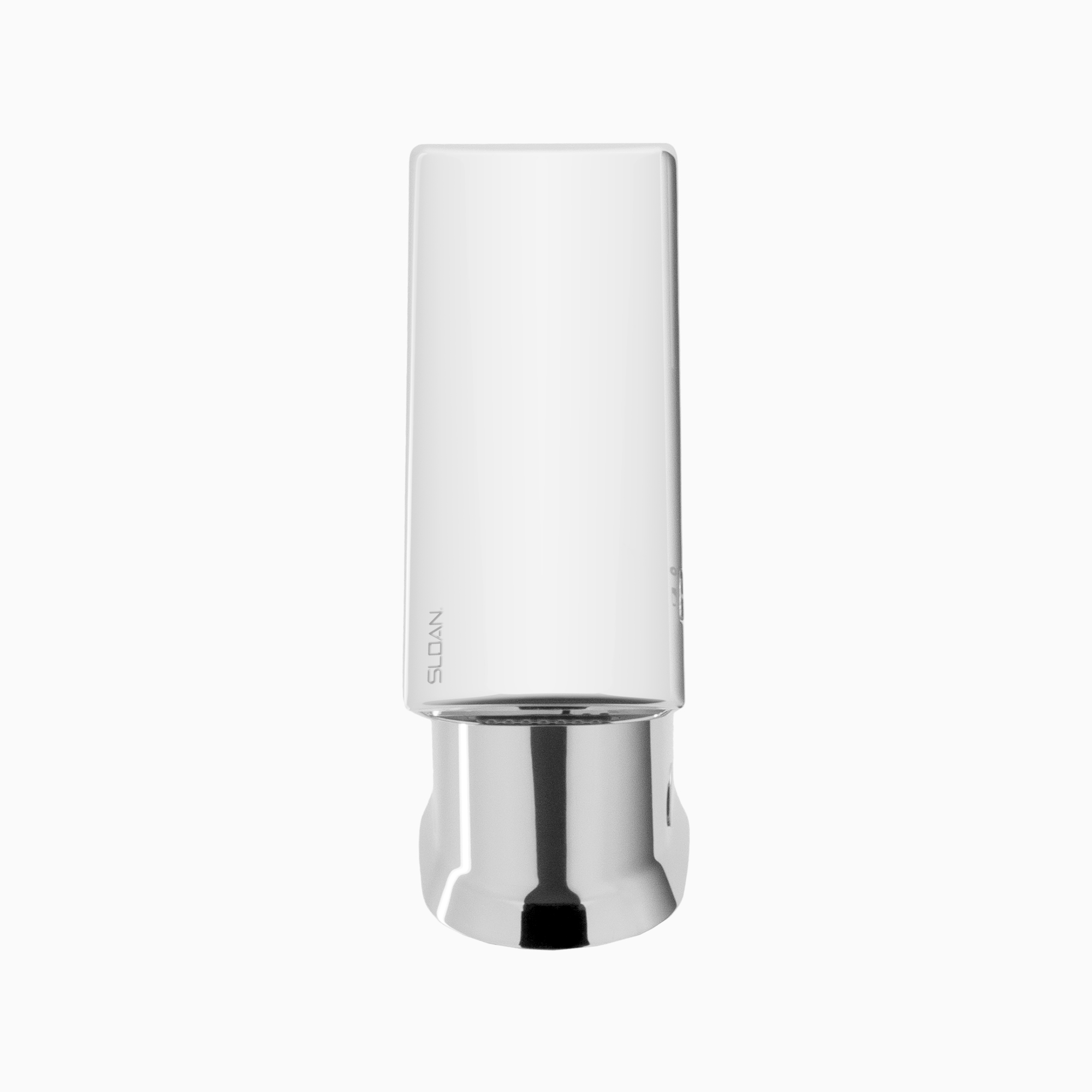
Sensor Activation and Commissioning
Identify the sensing method before comparing range claims. Infrared, capacitive and other sensing approaches need model-specific installation and setup procedures. A stated maximum detection distance does not describe the complete activation field or prove reliable performance over the selected basin.
- Test approach, hand removal and unintended activation.
- Check neighboring fixtures and reflective surfaces.
- Record configured timeout and restart behavior.

ADA Lavatory Planning
Assess the assembled station, including clear approach space, knee and toe clearance, operable parts and protected exposed plumbing. The Access Board guide identifies a 34-inch maximum rim or counter height for applicable accessible lavatories, whichever surface is higher. A faucet’s accessibility claim does not resolve the rest of the installation.
- Keep control boxes and reservoirs outside required clearances.
- Coordinate usable reach to water, soap and drying provisions.
- Review room type and exceptions before applying a detail.

Rated Flow and Actual Delivered Volume
Record the flow rating, test pressure and selected outlet insert. Confirm delivered flow in the installed system rather than assuming the catalogue value will be achieved under every condition. Public lavatories, private bathrooms and specialized clinical sinks should not automatically share one flow specification.
EPA WaterSense labeling criteria cover qualifying private lavatory and bar sink faucets, not public lavatory or metering faucets. Use the correct application category when reviewing efficiency claims.
Flow Documentation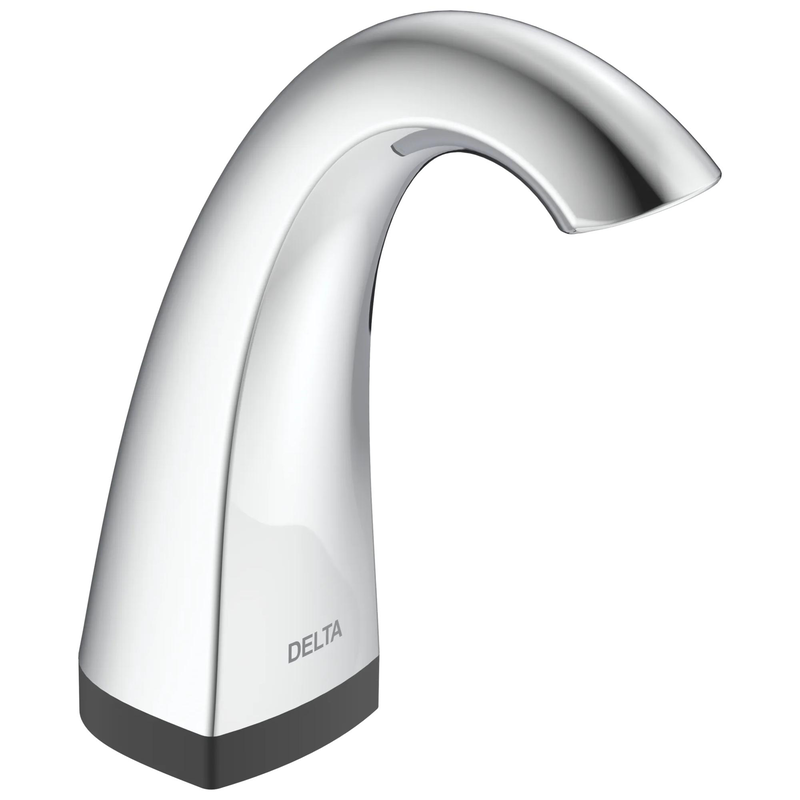
Power Architecture and Service Access
Distinguish battery operation, plug-in power, hardwired supplies and any documented backup arrangement. Confirm the exact power kit, voltage, cable length and permitted connection method. Include access to the solenoid, strainer, isolation valve and power supply in the coordinated detail.
- Record the manufacturer’s power-loss behavior.
- Locate battery access without obstructing the basin or trap.
- Check transformer capacity for any shared-power arrangement.
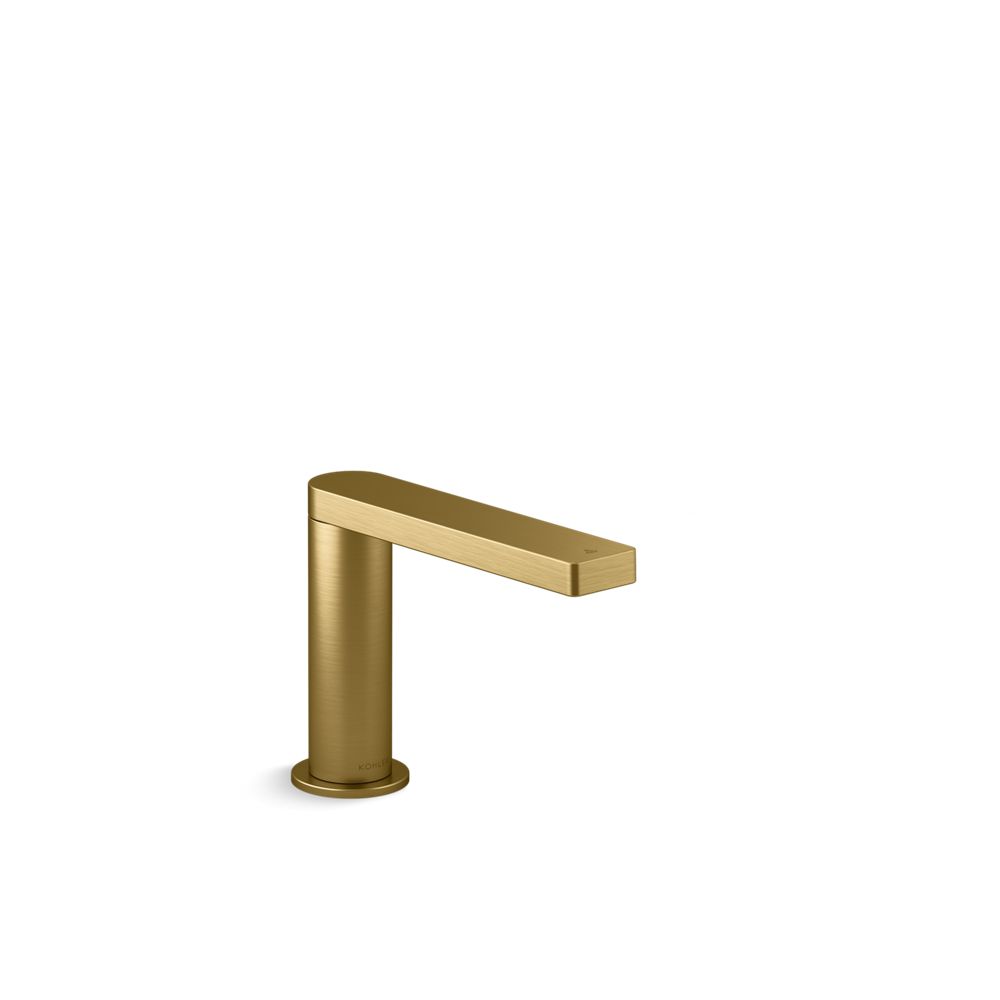
Kohler: Finish Durability and Cleaning Compatibility
Review the finish code, cleaning instructions, warranty exclusions and replacement-part availability. Appearance does not establish resistance to every disinfectant or abrasive cleaner. Compare maintenance needs using the facility’s actual products, cleaning frequency and water conditions.
- Separate exterior finish claims from wetted-material compliance.
- Confirm approved cleaning of sensor windows and outlets.
- Match replacement components to the exact model revision.

BathSelect: Sensor Faucet and Soap Dispenser Coordination
BathSelect adds a coordinated faucet-and-dispenser option to this research hub. The illustrated BS1094GM combines a brushed gold infrared faucet with a matching manual soap dispenser shown; the dispenser is not a touchless device. Confirm the selected dispenser option, mixer and power arrangement in the actual order.
For an AEC review, overlay the faucet outlet, sensor field and soap discharge point on the basin section. Confirm comfortable hand movement between water and soap, adequate deck spacing, and access to the dispenser reservoir and faucet service components.
- Architecture: coordinate finish samples, spout reach, deck openings and refill access.
- Engineering: verify the exact flow outlet, inlet conditions, mixing arrangement and power kit from current submittals.
- Construction: confirm which accessories are included before rough-in and procurement.
- Operations: record compatible soap, refill method, cleaning instructions and replacement-part access.
Apply the same documentation checks to BathSelect, FontanaShowers and every other shortlisted brand. A coordinated appearance does not establish certification, installed accessibility or equivalent performance.
Assembly CoordinationTechnical Questions to Resolve Before Procurement
Mixing and Temperature Control
Confirm inlet arrangement, mixing-device minimum flow, inlet-pressure limits and service access. A manual mixing handle is not evidence of thermostatic protection. Specify any required temperature-limiting device and verify performance at the selected faucet’s actual flow.
Use the VA Plumbing Design Manual as a healthcare engineering reference where relevant; its requirements are specific to VA projects.
Potable-Water Documentation
Request model-specific certification evidence for the intended use. EPA defines lead-free plumbing products using a weighted average of 0.25% lead across wetted surfaces for applicable pipes, fittings and fixtures. This is not a claim that every component contains zero lead.
Review the EPA lead-free requirements , including scope and exemptions, instead of relying on a generic material description.
BIM and Rough-In Accuracy
Use a BIM object that matches the ordered configuration. Check mounting centerlines, deck openings, finished-wall buildup, supply connections and maintenance envelopes against the latest submittal. A visually accurate model can still omit a controller, mixer or power supply.
Water Age and Purge Settings
Where automatic purge is available, document its trigger, duration, flow and reset logic. A faucet cycle is not proof that upstream pipework is adequately managed. Healthcare projects should coordinate settings with the facility’s water-management team and CDC healthcare water guidance .
Hot-Water Energy Demand
Evaluate water consumption separately from heating energy. Hot-water fraction, inlet temperature, delivery losses and heater efficiency affect the result. Lower water use can reduce heating demand, but a fixed percentage saving cannot be assumed for every installation.
The Department of Energy’s hot-water guidance explains the connection between water use and energy consumption.
Lifecycle Serviceability
Identify consumables, replacement valves, batteries, power supplies and access time. Compare like-for-like installation and maintenance assumptions across alternatives. Record parts availability and the work required to isolate a fixture without closing an entire restroom.
Match the Research to the Building Application
Private Bathroom Faucets
Review temperature adjustment, basin fit, cleaning access and the applicable private-lavatory efficiency category. A hotel guest-room faucet and a hotel lobby faucet may serve different uses and fall into different specification categories.
Public Commercial Restrooms
Prioritize intuitive activation, durability, appropriate flow, accessible use and repeatable service procedures. Standardize configurations only after checking basin geometry, power arrangements and the expected maintenance workload.
Variable Users and Peak Demand
Evaluate the expected user group, reach, approach, tamper resistance and simultaneous operation of adjacent stations. Include cleaning access and replacement planning. Peak occupancy does not by itself determine a single suitable sensor range or faucet height.
Clinical and Patient-Care Areas
Review patient population, basin depth, drain position, splash and premise-plumbing management with the healthcare team. CDC advises intentional sink design and positioning the stream away from the drain. Touchless activation alone does not establish infection-prevention performance.
Touchless Faucet Commissioning Checklist
Define acceptance criteria before installation and record the final settings. These checks organize a project review; manufacturer instructions and applicable project requirements determine the actual limits and procedures.
- Confirm the installed assembly Record model, finish, flow insert, power kit, mixer, basin and location.
- Inspect supply conditions Verify supply connections, isolation, strainers and manufacturer-required startup procedures.
- Measure delivered flow Record collected volume and elapsed time under the test conditions.
- Check temperature behavior Verify the approved outlet-temperature criteria and mixing-device operation.
- Test normal activation Observe hand entry, continued use, removal and the resulting shutoff.
- Test adjacent stations Check individual and simultaneous use, pass-by movement and soap dispensing.
- Verify fault and service behavior Review power interruption, low-battery indication and access to replaceable parts.
- Complete the handover record Retain settings, measurements, unresolved issues, manuals and staff training records.
Separate Sensor Timing From Water Delivery
Detection, controller processing, valve movement and arrival of water at the outlet are different events. When evaluating a response-time claim, record which event was measured, how it was measured and under what supply conditions. Avoid comparing values that describe different parts of the operating sequence.
How to Read the Evidence Behind a Faucet Claim
Government and Accessibility Guidance
Use official guidance to understand scope and applicable design criteria. Distinguish federal information, adopted local code and owner-specific requirements; they do not have identical applicability.
Manufacturer Documentation
Use current model-specific drawings, installation instructions and certification records. A family-level brochure or attractive product photograph is not a substitute for the ordered configuration’s technical data.
Project Measurements
Use documented mock-up or commissioning observations to assess the installed assembly. Record test conditions and limitations before extrapolating one station’s results to an entire building.
Bathroom Faucet Research FAQs
What makes a bathroom faucet suitable for a commercial project?
Suitability depends on the application, flow category, user group, installation geometry, power, service access and supporting documentation. A commercial label alone does not establish that a particular configuration meets every project requirement.
Does a touchless faucet automatically save water?
No fixed saving can be assumed. Consumption depends on delivered flow, activation duration, false activations, purge cycles and usage. Compare measured or clearly stated operating assumptions against a defined baseline.
Is a WaterSense label required for every public restroom faucet?
EPA does not provide WaterSense labeling criteria for public lavatory or metering faucets. Evaluate those applications using their applicable requirements, rather than treating a private-lavatory label as universal.
Can a faucet marked accessible make the whole sink installation compliant?
No. The assembly also needs the applicable approach space, clearances, reach, mounting arrangement and protection from exposed plumbing. Review the complete station using the Access Board guidance and governing requirements.
Which documents belong in the faucet submittal?
Include the exact order code, dimensional drawing, outlet and flow data, installation instructions, power arrangement, mixing details, relevant certification evidence, cleaning instructions and service information.
Turn Research Into a Reviewable Fixture Schedule
| Review item | Required evidence | Coordination question |
|---|---|---|
| Application | Room use and owner requirements | Private bathroom, public lavatory or specialized use? |
| Geometry | Faucet drawing and basin section | Where does the stream land, and is there useful hand clearance? |
| Flow | Outlet code, rating and test pressure | Does the configuration match the required application? |
| Accessibility | Coordinated station elevation and approach plan | Are controls, clearances and exposed services addressed? |
| Sensing | Setup instructions and installed observations | Does the activation zone work with this basin and surroundings? |
| Power and mixing | Selected kits, electrical details and mixing-device data | Are all components included and serviceable? |
| Materials | Applicable model-specific certification evidence | Are wetted-material and finish claims clearly separated? |
| Maintenance | Cleaning instructions, parts list and access detail | Can routine service occur without unnecessary demolition? |
Compare Connection and Control Strategies
| Strategy | Potential advantage | Review before selection |
|---|---|---|
| Manual faucet | No electronic power supply to service | Operability, handle clearance, mixing and user-controlled run time |
| Battery touchless | May simplify electrical work in some retrofits | Battery access, replacement workload and depletion behavior |
| Plug-in touchless | Continuous supply without routine battery replacement where no batteries are used | Accessible suitable receptacle, cable route and power-loss response |
| Hardwired touchless | Can support planned building-wide power coordination | Electrical installation, transformer compatibility and service isolation |
Flow Rate and Daily Water Volume
Assume 300 uses per day and 12 seconds of water-on time per use. These are arithmetic scenarios, not recommended flow settings for every faucet application.
Gallons/day = uses/day × seconds/use × gpm ÷ 60
Illustrative 10-Year Cost Allocation
Assumed undiscounted budget for one station: US$4,000 over 10 years. This is a worksheet example, not a current price estimate.
- Hardware: $1,200 / 30%
- Installation: $800 / 20%
- Water and sewer: $600 / 15%
- Maintenance: $1,200 / 30%
- Power and batteries: $200 / 5%
| Input | Example | Project verification |
|---|---|---|
| Daily use | 300 activations | Use measured counts or identified occupancy assumptions. |
| Water-on duration | 12 seconds per use | Measure operating time separately from the hygiene procedure. |
| Flow | 0.5, 1.0 or 1.5 gpm | Use the installed outlet and measured operating conditions. |
| Volume check | 300 × 12 × 0.5 ÷ 60 = 30 gal/day | Add cleaning, purge and other relevant consumption. |
| Cost check | $1,200 + $800 + $600 + $1,200 + $200 = $4,000 | Use the same time horizon and scope for all alternatives. |
Technical Reference Library
Use these sources alongside current product submittals and the requirements adopted for the project location. Manufacturer links and image credits appear beside the relevant research cards.
Lavatory geometry, operable parts, approach space and exposed plumbing.
Lavatory GuidanceFaucet efficiency categories, labeling scope and private-lavatory performance information.
Efficiency CriteriaLead-free definitions, certification requirements, scope and exemptions.
Material RequirementsWater-use and hot-water energy considerations; residential guidance should not be treated as a commercial design standard.
Energy ResearchHealthcare water management and sink/drain exposure considerations.
Healthcare CoordinationHealthcare plumbing design and commissioning reference with VA-specific applicability.
Design ReferenceResearch Scope
This page provides specification research and coordination prompts. Product images illustrate particular models or environments, not verified project outcomes. Confirm current model availability, certification scope and installation instructions before procurement. The numerical charts are illustrative calculations with stated assumptions.